



.jpeg)
Read summarised version with:

ChatGPT

Gemini

Claude

Grok

Add as preferred on Google
When you start renting out property, your main focus is often on finding tenants and fixing faulty boilers. But there is a silent partner in your business who always demands its share: HMRC.
Understanding exactly how much landlord tax you need to pay is the difference between a profitable portfolio and an unexpected financial black hole.
The scale of the sector is huge. In the 2023 - 24 tax year, roughly 2.86 million unincorporated landlords declared rental income to HMRC, reporting a massive combined property income of about £55.5 billion.
That is a lot of taxable revenue, and with the rules shifting constantly, knowing where you stand is a must.
This guide breaks down the different types of tax you might face and how the recent 2025 Budget changes could impact your bottom line.
Income Tax on Rental Profits
The most immediate landlord tax you will encounter is Income Tax. Unlike a company, private landlords don't pay Corporation Tax. Instead, your rental profit (income minus allowable expenses) is added to your other personal income (like your salary or pension) to determine your tax band.
It’s worth noting that the average declared rental income per landlord was about £19,400 in 2023 - 24, the highest figure in the past five years. For many, adding this amount to an existing salary is enough to push them into a higher tax bracket, significantly increasing the rate they pay on every extra pound earned.
The Personal Allowance
Everyone in the UK has a standard Personal Allowance (currently frozen at £12,570 until 2031).
If your total income is below this, you pay no tax. Once you exceed it, the rates kick in.
However, following the November 2025 Budget, these rates have shifted for property income (see below).
%20(1).jpg)
The Autumn Budget 2025 Impact
The November 2025 Budget delivered a significant shake-up for the private rented sector. While we have grown used to steady rates, the latest Office for Budget Responsibility (OBR) report outlines changes that directly target property income.
Landlords are now grappling with rate increases that tighten margins further. As one detailed breakdown on the r/UKLandlords subreddit explained regarding the November report:
"PROPERTY INCOME TAX RATES - ALL UP 2%: • Basic rate on rental: 20% → 22% • Higher rate: 40% → 42% • Additional rate: 45% → 47%... Bottom line for landlords: Depending on your portfolio, you could be looking at £2,000-10,000+ extra per year in tax."
This effectively introduces a surcharge on rental income compared to standard earnings. To add to this, the freezing of tax thresholds means that as rents rise with inflation, more of your income is dragged into these higher bands, a phenomenon known as fiscal drag.
National Insurance Contributions (NICs)
Many landlords assume they don't pay National Insurance on rent. Generally, that is true, but there is a catch.
You will have to pay Class 2 National Insurance if your profits are above the Small Profits Threshold and HMRC considers you to be "running a property business." So when does this apply? Typically, if being a landlord is your main job, you have multiple properties, and you are actively buying new ones, you’ll fall into this camp.
If you are struggling to calculate your true profit, there’s no shame in it. With tax rates rising, the landscape is more complex than ever, and missing an expense can be devastatingly costly.
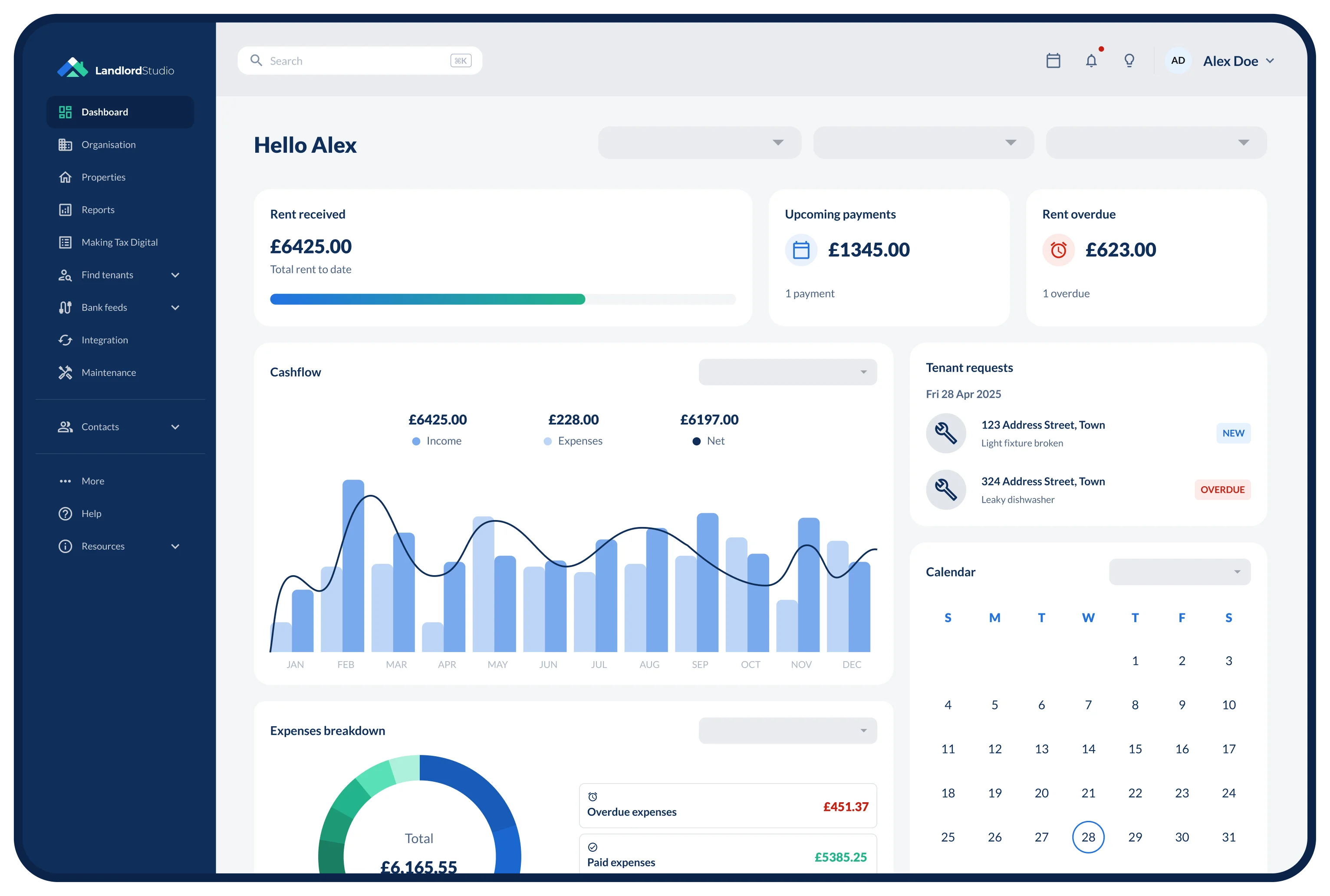
With Landlord Studio, you can track every penny as it happens, giving you a crystal-clear view of your tax position long before the deadline hits.
Stamp Duty Land Tax (SDLT)
This is the tax you pay on the purchase of a property. For landlords, the costs are higher than for residential buyers.
If you buy a buy-to-let property or a second home, you will have to pay a surcharge on top of the standard SDLT rates. This extra 5% applies to the entire purchase price if the property costs more than £40,000. Without meaning to state the obvious, this can end up being a huge upfront cost, especially if you’ve got your eye on an expensive property.
You might also like our Buy to Let Stamp Duty Land Tax Calculator
Capital Gains Tax (CGT)
Landlord tax isn't just about what you earn… it's also about what you sell. When you sell a rental property that isn't your main home, you pay Capital Gains Tax on the profit.
The ‘gain’ counts as the difference between what you paid for the property originally and what you ended up selling it for, minus costs such as stamp duty, any solicitor fees, and capital improvements (for instance, building an extension).
Like Income Tax, CGT rates for residential property are higher than for other assets (like shares). If you are a higher-rate taxpayer, the government takes a hefty slice of your long-term appreciation.
Making Tax Digital (MTD) for Income Tax
While not a new tax rate, this is a massive change to how you pay your tax. Making Tax Digital for Income Tax Self Assessment (MTD for ITSA) is effectively retiring the annual tax return in favor of continuous digital reporting.
From 6 April 2026, if your total qualifying income (that's property plus self-employment) tops £50,000, you’ll need to keep digital records and send updates to HMRC every quarter. The net widens in April 2027 to cover those earning £30,000, and finally drops to £20,000 by April 2028.
Under MTD, the days of digging out a shoebox of receipts in January are over. You will need to make sure you are prepared if you want to manage your landlord taxes effectively and stay out of trouble with HMRC.
Here are the key things you’ll need to do:
- Use HMRC-compatible software (like Landlord Studio) to track income and expenses as they happen.
- Send quarterly updates to HMRC to give them a snapshot of your finances.
- File a Final Declaration by 31 January to confirm your tax position.
Failing to prepare for these changes could land you some penalties if your records aren't up to scratch when the deadlines hit.
Staying Ahead of Landlord Tax Changes
The days of passive income are largely over. Between the new "rental surcharge" rates introduced in 2025, the 5% Stamp Duty surcharge, and the freezing of thresholds, the tax burden on landlords is heavier than ever.
To survive in this market, you need to treat your portfolio like a business. That means claiming every single allowable expense you are entitled to and forecasting your tax bill months in advance.
Don't let the new tax rates catch you off guard. Create your free Landlord Studio account today and take control of your property finances.