




Read summarised version with:

ChatGPT

Gemini

Claude

Grok

Add as preferred on Google
As a UK landlord, understanding which landlord expenses you can claim is the difference between overpaying HMRC and maximising your rental yield.
Every legitimate expense you fail to claim is effectively a voluntary donation to HMRC. Yet, it happens constantly.
Here is a stat that might surprise you: in the 2023-2024 tax year, 12.3% of landlords didn't claim a single expense. Not one.
That means thousands of property owners are likely overpaying tax simply because they lost receipts or weren't sure what was allowed.
You don't want to be in that group.
📢 REGULATORY UPDATE — January 23, 2026
The Government has announced critical changes to the Minimum Energy Efficiency Standards (MEES) spending requirements that will affect your expense planning:
• The spending cap for EPC improvements has been reduced from £15,000 to £10,000 per property
• Lower spending caps apply incrementally for homes valued under £100,000
• All improvements made from October 2025 onwards count within this cap
• Low-interest loan funding support will be available for the sector
• The 2028 interim deadline has been axed, giving landlords until 2030 to reach EPC band C
These changes mean more predictable budgeting for energy efficiency improvements. Be sure to track all qualifying expenses from October 2025 onwards.
Understanding Landlord Expenses: The Basics
Before we dive into specific expenses, here's the principle that governs everything: HMRC allows you to deduct any cost incurred "wholly and exclusively" for your rental business. If a cost was necessary for earning rental income, it's likely allowable. If it was for personal benefit, it's not.
Revenue vs. Capital: The Critical Distinction
Most landlord expense confusion comes down to one question: is this a day-to-day running cost (revenue) or a property improvement (capital)?
Revenue expenses are your regular costs, such as repairs, insurance, agent fees, and bills during void periods. These are fully deductible against rental income in the year you incur them.
Capital expenses, on the other hand, improve or enhance your property beyond its original state, such as extensions, major upgrades, and initial furniture purchases. You can't deduct these from rental income, but they may reduce Capital Gains Tax when you sell. To claim capital expenses, you will need to ensure the accounting system you employ allows you to easily mark these expenses and apply them to the relevant property.
A new boiler replacing a broken one? Revenue (repair). Adding central heating where there wasn't any? Capital (improvement).
Why Tracking Matters More Than Ever
If you can't prove an expense happened, HMRC won't allow it. And with Making Tax Digital for Income Tax, which started in April 2026, landlords with qualifying income above the threshold must keep digital records and submit quarterly updates using HMRC-recognised software.
The old shoebox-and-receipts method won't work anymore.
This is why landlords are switching to purpose-built software like Landlord Studio.
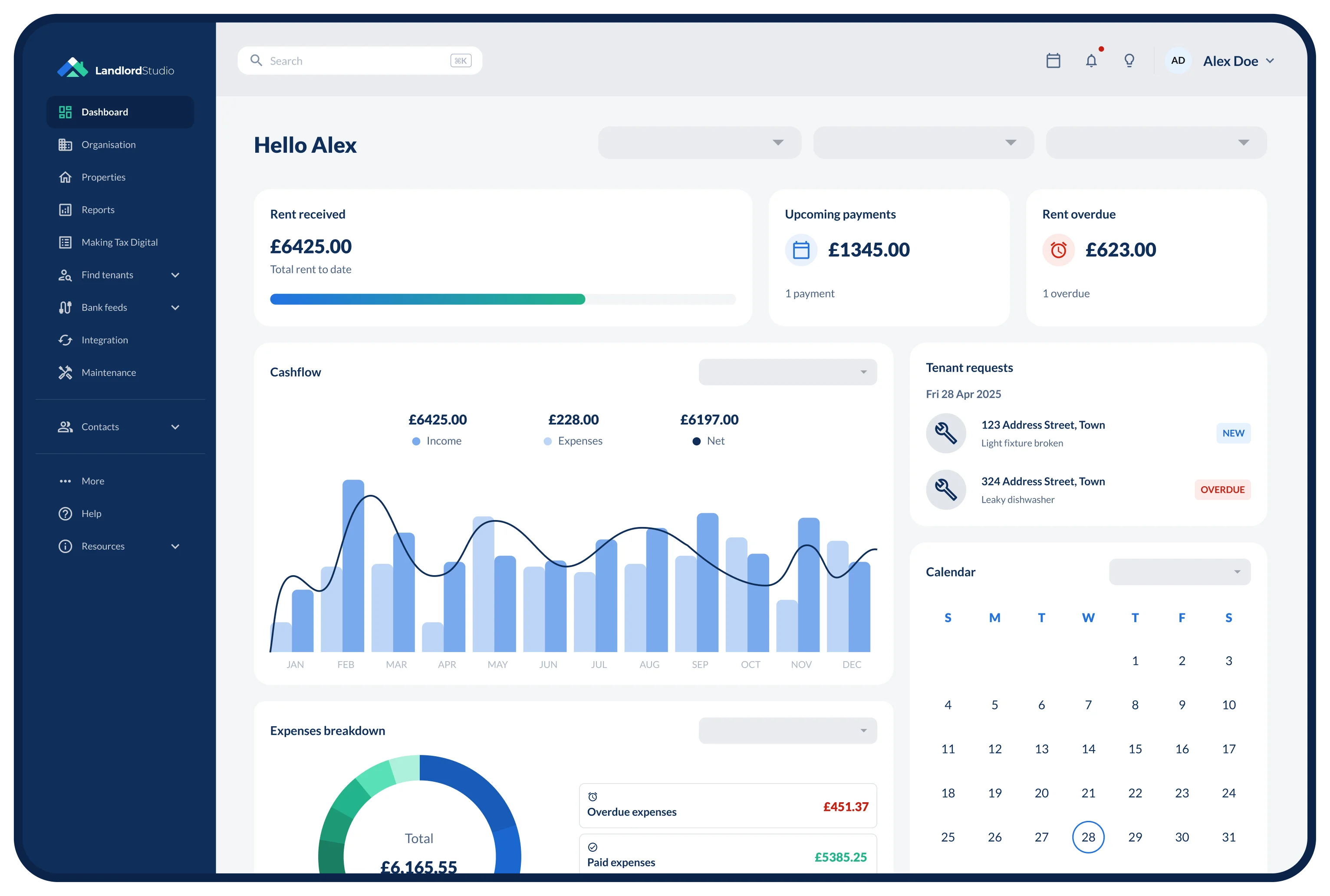
Digitise receipts with the app, track expenses on a property-by-property basis, assign joint ownership percentages, automate income and expense tracking with bank feeds, and instantly generate any of over 15 customisable reports.
More importantly, Landlords who properly track expenses typically save £2,000-£5,000+ in tax annually by claiming every allowable deduction. Those who don't keep good records leave significant amounts unclaimed.
Make Landlord Expense Tracking Simple
.png)
Make rental property income and expense tracking simple with property management and accounting software designed for you. Landlord Studio is HMRC-recognised and MTD compliant.
Create your free Landlord Studio account today for streamlined and accurate accounting.
7 Common Landlord Expenses
To keep your tax bill fair, here are the seven key landlord expenses you really need to keep an eye on.
1. Repairs + Maintenance
Consistently one of the largest landlord expenses, the repairs and maintenance category is also the most misunderstood. You can claim for costs that restore your property to its original condition, but not for improvements that add value.
Claimable
Painting and decorating, fixing a broken boiler, replacing a smashed window, or mending a leaky tap.
Not Claimable (Capital Cost)
Adding an extension or upgrading a standard kitchen to a high-spec luxury one.
There are certain fringe cases where it's not entirely clear whether something is a repair or a maintenance cost.
For instance, if you replace an item with the nearest modern equivalent (like replacing single glazing with double glazing), HMRC generally accepts this as a repair, not an improvement.
2. Insurance Premiums
Standard home insurance usually won't cover a rental property. You need specific landlord insurance, and the good news is that the premiums are fully tax-deductible.
As well as buildings insurance, you can also claim for rent guarantee insurance, contents insurance (if you provide furniture), and liability insurance (this is in case a tenant or visitor is injured).
3. Legal, Management, & Professional Fees
If you use a letting agent to find tenants or manage the property, every penny of their fee is an allowable expense. That includes tenant finding fees, referencing costs, and inventory checks.
It's easy to forget the smaller professional costs, too. Are you a member of a landlord association like the NRLA? That subscription is deductible. Do you pay an accountant to help with your self-assessment? That fee is also an allowable business expense.
If you're struggling to keep these receipts organised, it may be time to stop stuffing them in a drawer. Using a dedicated tool like Landlord Studio allows you to snap a picture of a receipt the moment you get it, digitising the data and making sure you never lose a deductible expense again.
4. Ground Rent and Service Charges
If you're letting out a leasehold flat, you know how painful those monthly or annual bills can be. But the silver lining is that they are legitimate business expenses.
Whether it's the ground rent paid to the freeholder or the service charges for keeping the hallways and gardens in check, you can offset the cost against your rental income.
Just remember that while the running costs are claimable, the actual cost of buying the lease in the first place is a capital cost, so keep that separate.
💡 Pro Tip: MTD-Ready Expense Tracking
With Making Tax Digital for Income Tax live since April 2026, you need accurate digital records of all landlord expenses as they happen. Become MTD-ready with Landlord Studio. Default expense categories in-line with HMRC requirements, bank feeds for fast, real-time accounting, property by property tracking, joint ownership splits, and direct HMRC integration for streamlined MTD submissions.
5. Replacement of Domestic Items Relief
The Replacement of Domestic Items Relief took over from the old "Wear and Tear Allowance" back in 2016. It's a lifesaver for furnished lets.
It applies when you replace movable items provided for the tenant's use.
This includes:
- Movable furniture (beds, sofas, wardrobes).
- Household appliances (fridges, washing machines).
- Kitchenware (crockery, cutlery).
You need to know, however, that you can only claim the cost of the replacement, not the initial purchase. So, buying a sofa for the first time isn't claimable, but replacing an old, broken sofa with a new one is.
6. Utilities + Council Tax (During Void Periods)
While your tenant is usually responsible for the bills, the liability falls back to you whenever the property is empty.
Any council tax, water rates, gas, or electricity bills you pay while the property is between tenants are valid business expenses.
Keep a close eye on those dates. If a void period spans a few weeks, those costs add up and should be deducted from your profit.
7. Direct Administrative Costs
These are the hidden costs of running your business that you are not always consciously aware of.
Although they might seem small individually, they add up over a tax year and are well worth keeping track of.
Mileage
You can claim for travel to your property for inspections, maintenance, or tenant check-ins. You can currently claim 45p per mile for the first 10,000 miles.
Office Costs
This includes phone bills (the business proportion), postage, stationery, and the cost of software, like Landlord Studio, that is used to manage your properties.
The Reality Check: What Landlords Actually Spend
It's easy to underestimate how many landlord expenses you'll face until you're actually tracking them.
As one experienced landlord on r/UKPersonalFinance warned a newcomer, calculating potential profit:
"You forgot about insurance, gas safety check, boiler service, EICR, EPC, inventory, credit checks, rental voids, repairs and maintenance, etc etc. Do yourself a favour... Don't." Reddit user, r/UKPersonalFinance
While the tone is cautious, the list is accurate. From safety certificates (Gas Safety, EICR, EPC) to repairs to void periods, these regular operating costs are exactly where your profit margins and your tax deductions live.
Stay Organised for MTD
With Making Tax Digital (MTD) for Income Tax, which changed the reporting landscape from April 2026, the days of estimating expenses or relying on bank statements at the end of the year are over. You need a digital record of these expenses as they happen.
Landlords who build these habits early find MTD straightforward. Those who wait until their start date face a stressful scramble.
By accurately tracking these seven expense categories, you'll not only be MTD-ready but you'll maximise your tax deductions today. The average landlord claims £500 more in expenses per year when they use software instead of spreadsheets.
By tracking these seven common expense categories accurately, you'll not only be ready for the tax changes, but you'll also make sure you're maximising your rental income today.
Don't let allowable landlord expenses slip through the net. Create your free Landlord Studio account today and make tax time effortless.